
Wellness marketing often gravitates toward consumers who are already interested in health. They understand the language of fitness, nutrition, sleep, recovery, self-care, and preventive health, which makes it easier for brands to communicate product benefits and move relatively quickly toward consideration and conversion.
In Japan, however, focusing too heavily on existing wellness consumers risks overlooking a potentially valuable audience: men in their 40s and 50s who have not yet made health and wellness a significant part of everyday life.
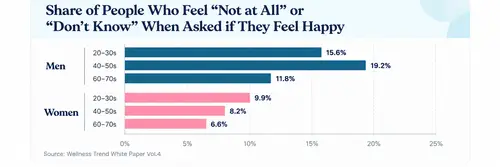
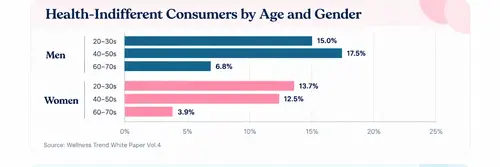
Research published by Japan’s Wellness Research Institute (ウェルネス総合研究所) provides an interesting perspective on this group. Its Wellness Trend White Paper Vol. 4, based on an internet survey of 4,531 people aged 20 to 79 across Japan, divides consumers into seven segments according to health attitudes and behavior. Among its findings, men in their 40s and 50s had the highest representation in the least health-engaged segment, described as the “health-indifferent” group. The research also found that men in their 20s and 30s showed greater interest than those in their 40s and 50s in technologies designed to assess biological aging.
For wellness brands, lower engagement does not necessarily make this audience less interesting. Instead, it changes the marketing task. Rather than expecting immediate demand, brands can create relevance earlier, help consumers recognize where wellness fits into their lives, and build familiarity before their needs become more pressing.
Why wellness marketing gravitates toward younger consumers
Younger consumers are highly visible across fitness, beauty, nutrition, mental wellbeing, and lifestyle culture, while concepts such as supplements, wearable technology, sleep tracking, and preventive care may already be familiar to them. This existing category awareness reduces part of the educational burden for marketers because brands can often begin further down the funnel, discussing particular needs, product differences, or reasons to purchase.
The Wellness Trend White Paper Vol. 4 challenges the assumption that younger people are naturally less interested in health because they face fewer age-related concerns. Its research found that health awareness among men in their 40s and 50s was actually lower than among younger men in several respects, with roughly one in five middle-aged men falling into its least health-engaged segment.
For brands, this creates an opportunity to build relevance among consumers who have not yet made wellness a priority.
Why wellness may feel less relevant in the 40s and 50s
Men in their 40s and 50s should not be treated as actively opposed to wellness simply because they show lower engagement. A more useful question is whether existing wellness language, propositions, and creativity give them a sufficiently compelling reason to pay attention.
For many people at this life stage, work and family responsibilities occupy much of everyday life, while changes in sleep, energy, recovery, stress, or physical condition can be absorbed into the normal experience of getting older. Health may therefore remain something to address later rather than a category around which they organize their identity or spending.
This matters because messaging built around optimization, transformation, aspirational fitness identities, or participation in wellness culture may have limited relevance. Brands can instead connect health to recognizable outcomes, such as:
- maintaining energy through the working day
- recovering after demanding weeks
- sleeping more consistently
- staying active with family
- maintaining stamina for hobbies, travel, and everyday life
- remaining capable and independent over the next 10 to 20 years
This approach makes wellness more concrete without requiring someone to adopt a new identity as a “wellness consumer.”
Why this audience still represents a valuable growth segment
The White Paper also highlights differences between middle-aged and older male consumers, with health awareness generally stronger among men in their 60s and 70s than among those in their 40s and 50s. However, the researchers make an important qualification: today’s middle-aged men should not simply be expected to develop the same health attitudes as today’s seniors as they get older. Generational experience also matters, and health awareness does not necessarily rise automatically with age.
For marketers, that qualification strengthens the case for earlier engagement. If stronger health awareness cannot simply be assumed to appear later, brands have a reason to help create relevance now rather than wait for consumers to enter the category by themselves.
This is particularly relevant for supplements, fitness services, preventive health programs, memberships, and digital health platforms, where long-term engagement can be more valuable than a single transaction.
If this audience is less heavily targeted by wellness advertisers, it may also offer an opportunity for efficient awareness building, although media costs and competitive intensity should be tested at campaign level rather than assumed.
The more important advantage is strategic: brands willing to develop demand have an opportunity to establish familiarity before the consumer is actively comparing solutions.
Start with education, not immediate conversion
Product-first advertising works best when consumers already understand the problem and recognize the category as a possible solution, so pushing immediately for purchase can create a mismatch when that awareness is still weak.
For less-engaged men in their 40s and 50s, the first objective may therefore be recognition. Brands can connect health with familiar experiences rather than beginning with the product itself, helping consumers notice how sleep, stress, energy, recovery, or daily habits affect areas of life they already value.
The tone is particularly important. Fear-based communication about aging or declining health may attract attention, but it can also make the brand feel alarmist or judgmental. A more sustainable approach is practical and preventive, positioning better health as a way to continue working, spending time with family, enjoying hobbies, traveling, exercising, or simply feeling capable in everyday life.
Build the funnel around changing awareness
The same message should not be used from first exposure through to conversion. A more deliberate funnel can move consumers through four broad stages:
- Recognition: Make the issue personally relevant through concerns such as energy, sleep, stress, recovery, or stamina.
- Awareness: Introduce practical information, everyday habits, expert guidance, and relevant solution categories.
- Consideration: Connect the recognized need with a particular product or service through benefits, use cases, FAQs, demonstrations, and appropriate proof points.
- Action: Focus on trial, purchase, consultation, subscription, membership, assessment, or another suitable conversion once stronger intent is visible.
Retargeting can bridge these stages. Someone who watches much of an educational video, reads an article about sleep or recovery, or returns to related content is sending a different signal from someone encountering the brand for the first time. Subsequent advertising can therefore become progressively more solution-focused instead of repeatedly serving the same awareness message.
A campaign might begin by discussing why energy levels can feel different in the 40s, follow with practical content about maintaining energy and recovery, and then introduce how a relevant product or service fits into an everyday routine.
For brands targeting this audience, intentional campaign design means matching the message to the consumer’s current level of awareness, using engagement signals to change what they see next, and adapting creative, copy, and offers as they move closer to action.
Creative should reflect the audience’s life
Campaigns for men in their 40s and 50s should be designed for that audience rather than simply adapting assets created for younger wellness consumers.
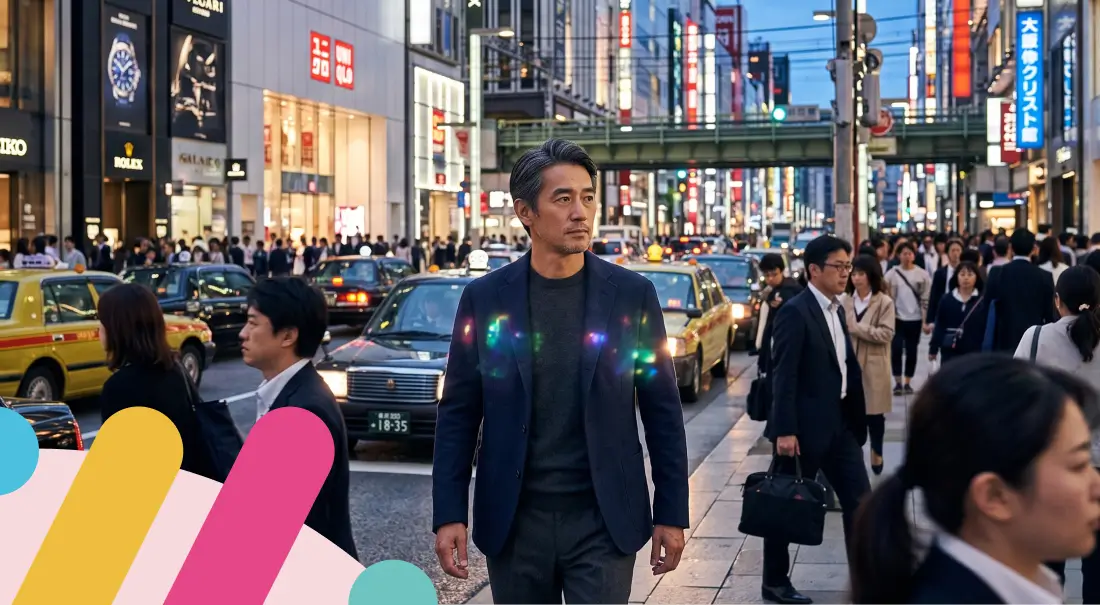
Imagery can feel mature, contemporary, realistic, and trustworthy, with settings that reflect recognizable life in Japan, including work, commuting, family time, recreational activity, and everyday routines. Extreme physiques, heavily youth-coded aesthetics, influencer-style imagery, or unrealistically polished wellness lifestyles may create distance rather than relevance.

Copy should follow the same principle. Abstract promises around optimization or transformation can be replaced with clear outcomes linked to everyday life. The underlying message is not “become a wellness person,” but rather that manageable health decisions can support the people, responsibilities, and activities that already matter.
Segment the middle-aged male audience carefully
Age and gender are useful starting points, but “Japanese men aged 40–59” is too broad to function as a complete audience strategy. A man in his early 40s with young children, a physically active executive in his 50s, and someone approaching retirement may share a demographic label while responding to very different motivations.
Brands can test segmentation according to:
- age band and family stage
- working status and professional demands
- fitness engagement and existing health behavior
- media consumption and previous campaign engagement
- motivations such as performance, sleep, family, mobility, or long-term capability
- response to different messages, formats, and offers
The objective is to identify which messages create recognition and which groups progress from passive exposure toward meaningful engagement. Campaign data can then determine where further investment is justified rather than assuming that an entire age group behaves in the same way.
Think beyond customer acquisition
For this audience, a more useful strategic question than “How can this person be made to buy today?” is “How can the probability that this person chooses the brand when wellness becomes more relevant be increased?”
That longer view is particularly suitable for consumers who may not yet demonstrate strong health intent. Educational content, social media, email, LINE, useful guides, seasonal campaigns, assessments, and retargeting can maintain appropriate contact without turning every interaction into a sales message.
Over time, the brand can move from unfamiliar advertiser to a recognizable source of useful information, giving it an advantage when wellness becomes more relevant to the consumer.
Build tomorrow’s wellness audience today
Japanese men in their 40s and 50s should not be ignored simply because current research indicates comparatively low levels of health awareness. Their behavior should shape how wellness brands market to them, rather than determine whether they are worth addressing at all.
The Wellness Trend White Paper Vol. 4 also provides an important warning against simplistic assumptions. Today’s middle-aged men will not necessarily become as health-conscious as today’s 60- and 70-year-olds merely because they get older. That makes intentional audience development more important, not less.
For wellness brands exploring new growth segments in Japan, the opportunity may lie in reaching consumers before they are actively looking for solutions, making health relevant to their existing lives, and gradually building recognition, awareness, and trust. Age-appropriate creative, practical messaging, segmentation, and engagement-based retargeting can help brands develop that audience over time.
More broadly, this reflects an important reality of the Japanese market: growth opportunities are not always found by following the most visible demand. Careful segmentation can reveal audiences whose value depends on localized education, appropriate messaging, and patient customer development over time.
For health and wellness brands considering how to identify and develop less obvious growth audiences in Japan, Pulse Marketing can help connect market positioning, audience strategy, localized creative, and performance marketing into a coherent approach.