


Introduction: The Milestone and the Reality Check
The Global Shift
The headline is hard to ignore. New Similarweb estimates reported by TechCrunch show Threads at 141.5 million daily active users on iOS and Android as of January 7, 2026, compared with 125 million for X. It is a meaningful milestone, and a prompt to revisit channel roles rather than chase the latest narrative.
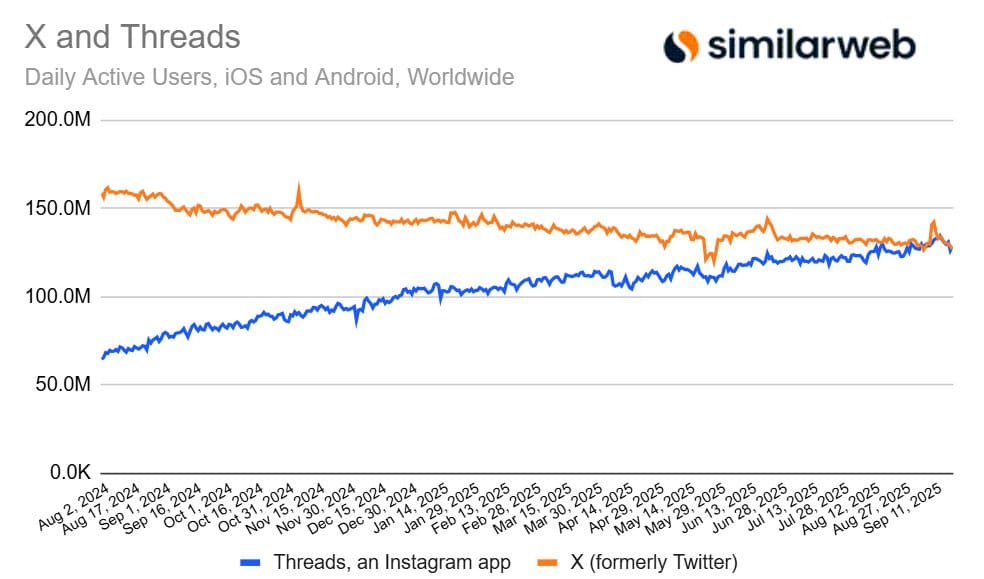
Platform shifts rarely create clean substitutions, especially for health and wellness brands. They usually redistribute attention across formats, contexts, and user intent, which means the right question is not “Threads or X,” but “What should each platform do inside a broader Japan strategy?”
While the global mobile DAU crossover matters, Japan’s landscape remains structurally distinct, so the best response is a measured, test-and-learn approach that supports platform diversification without impulsive switching.
Deconstructing the Data: Mobile DAU vs. Total Ecosystem
Why Mobile Usage Matters
Mobile DAU is valuable because it reflects habit. For wellness and lifestyle brands, many meaningful moments happen on phones: commutes, post-workout browsing, and quick micro-moments when people save tips, share routines, and follow creators.
The Web Traffic Factor
At the same time, mobile DAU is not the whole ecosystem. The same TechCrunch report notes that X still dominates Threads on the web, and Similarweb estimated that, as of January 13, 2026, X drew about 145.4 million daily web visits versus 8.5 million across Threads.com and Threads.net. That gap matters because web behavior often correlates with work-mode consumption such as research, news monitoring, and link-driven browsing.
In practical brand terms, web strength often shows up indirectly. It shapes how conversations travel via links, how media and creators track narratives, and how “search plus social” journeys play out when people jump between articles and platform threads. That is one reason X can remain strategically relevant even when mobile momentum is shifting.
The Japan Context: Why Global Trends Don’t Always Map to Local Behavior
Cultural Embedding
Japan has long been an outlier market for X, and that context is essential before translating global DAU headlines into local decisions. While definitions vary by source, a cross-country comparison on Statista also underscores how unusually large Japan’s X user base has been in global context. DataReportal’s 2025 analysis of X’s advertising audience places Japan among the platform’s largest territories, second only to the United States, with 70.9 million “active X users” by ad reach in January 2025. These figures are not the same as unique users, but they are a useful indicator of scale and market importance.
It also helps to zoom out. Japan is a highly connected, highly social market overall. DataReportal’s Digital 2025: Japan report notes 109 million internet users in Japan at the start of 2025, and 97.0 million “social media user identities,” equivalent to 78.6% of the population. Most consumers already live inside multi-platform habits, so diversification is not a novelty, it is the baseline.
That makes Japan structurally different from places where a single platform shift can feel like a clean replacement. In Japan, attention is naturally segmented across contexts such as creator discovery, entertainment fandoms, and real-time commentary. X’s strengths align with fast posting norms, event-driven participation, and lightweight engagement that does not require long-form production. For wellness categories, this supports consistent “presence marketing” that builds familiarity and trust over time.
Market Sentiment
For Japanese health and wellness marketing managers, the strategic posture is to treat global DAU shifts as input, then validate against local behavior. Threads can be tested with clear hypotheses, but X should remain optimized where it still delivers reach, cultural resonance, and discovery.
Algorithmic and Engagement Realities: Threads vs. X
Engagement Disparity
One reason Threads is attracting marketer attention is engagement efficiency. Neal Schaffer’s comparison, referencing Buffer’s analysis, reports a 2024 median engagement rate of 6.25% on Threads versus 3.6% on X, a difference of about 73.6% in the sample. This is not a guarantee for every brand, but it supports a broader pattern: Threads can deliver steadier interaction per post when content invites conversation.
Discovery Mechanics
The nuance is in how engagement behaves. Buffer’s 2025 analysis of 1.7 million posts shows that median engagement can look similar across platforms, while variance tells a different story. X has a much wider engagement spread, with a standard deviation over 5,000, which reflects a high risk, high reward environment where rare viral posts can distort averages. Threads is more predictable and rewards consistent, conversation-driven posting that encourages replies and sustained interaction.
Threads
Threads encourages slower reading and more back-and-forth discussion, and it can extend the life of a post when conversations continue in replies.
X
X behaves like a live information layer, where timeliness and trending context can unlock sudden reach, but the median post may perform modestly.
For health and wellness brands, this difference matters because trust-building tends to compound. Threads can suit education, routines, and community reinforcement, while X remains powerful for timeliness, cultural moments, and the occasional breakout post.
Comparative Brand Case Studies: US vs. Japan Strategies
Case Study 1: Nike (Brand Exposure & Product Focus)
US Strategy
Nike US posts identical content across X and Threads. There is no differentiated creative or no platform-native formatting. The uniform approach is not simply an efficiency decision. Posting the same content across both platforms is a long-term audience accumulation play: building a Threads community now, before committing to platform-native production, so that the audience base exists when the strategy matures. It is a low-cost way to establish presence and begin compounding reach without a differentiated content operation.


Japan Strategy
Nike Japan maintains no official Threads presence. Its X account is active and built around drop culture: limited releases, streetwear-adjacent content, and hype-driven moments that map directly to X’s real-time, high-frequency feed structure. This reflects something specific about how Nike is perceived in Japan. Nike is not primarily seen as an athletic performance brand in the Japanese market. It is positioned closer to fashion and lifestyle, and drop culture is central to that positioning. X’s speed, its role in real-time cultural conversation, and its concentration of sneaker and streetwear communities make it the right environment for that strategy. Threads, with its slower conversational rhythm and Instagram adjacency, does not serve the same function.

The lesson here goes beyond platform choice. Nike’s US and Japan approaches reflect two distinct strategic postures: Threads as a reach extension in a market where the content is already produced, versus X as the primary always-on channel in a market where cultural fit and community concentration drive the decision. For wellness brands, the equivalent question is whether Threads serves a differentiated purpose or simply duplicates reach. Both can be valid, but they require different resourcing and measurement frameworks.
Case Study 2: Unilever (Corporate Identity & HR)
US Strategy
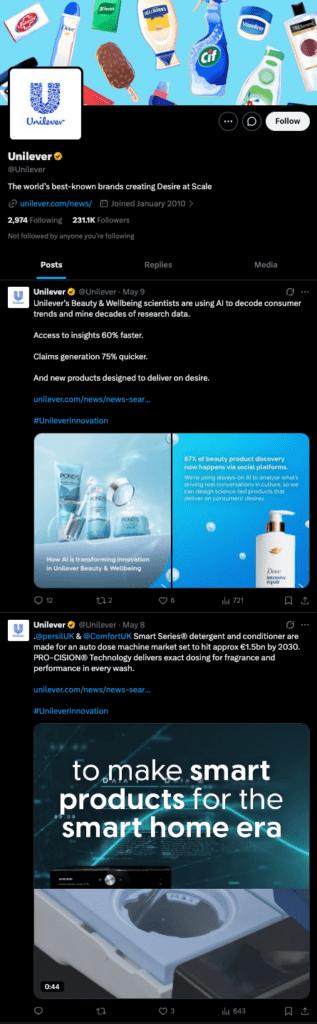
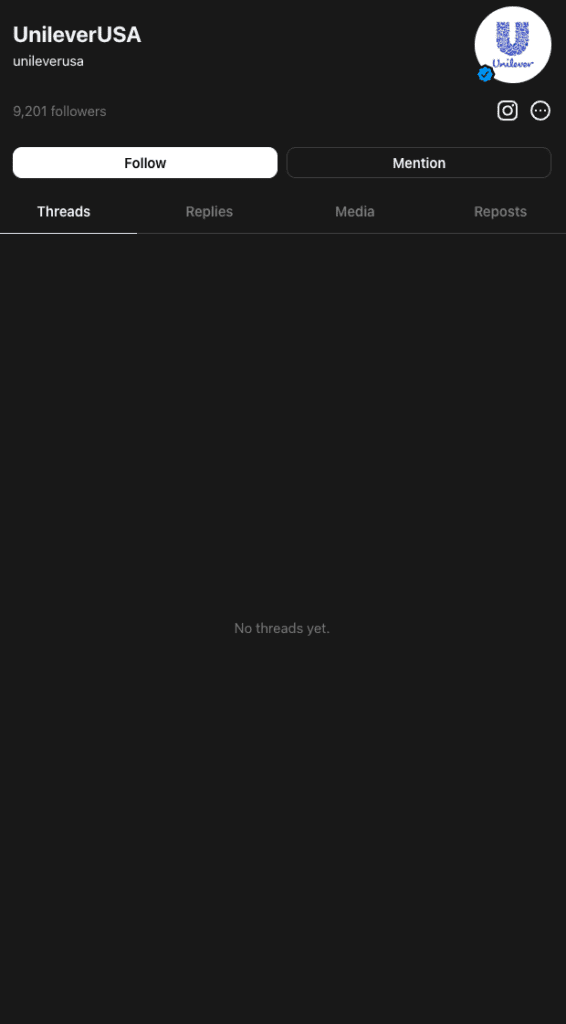
The US organization has historically operated multiple accounts and appears most active on Unilever on X, including branch accounts such as Unilever Ventures on X, while UnileverUSA on Threads has been comparatively quiet. Comparatively quiet is actually an understatement: the Threads account has zero posts. Unilever also runs Instagram with a tone nearly identical to X, polished, low-frequency corporate PR aimed at media, investors, and industry audiences rather than consumers. When a brand’s core challenge is explaining a parent company that most consumers never think about, there is no organic pull toward a platform built around conversation and community. The empty Threads account is not a deprioritization. It is the absence of any business objective that would justify the channel.
Japan Strategy
Unilever Japan’s X account has been inactive since 2016. This is not a gradual wind-down. It is a complete platform migration. Unilever Japan on Threads is now the active account, used primarily for employer branding and corporate messaging. The audience logic is straightforward: early-career professionals and university students, the primary target for recruitment communication, skew toward Threads’ demographic profile. Instagram ecosystem adjacency lowers the barrier to engagement for that cohort, and Threads’ feed environment suits the tone of employer branding better than X’s faster, more fragmented stream.
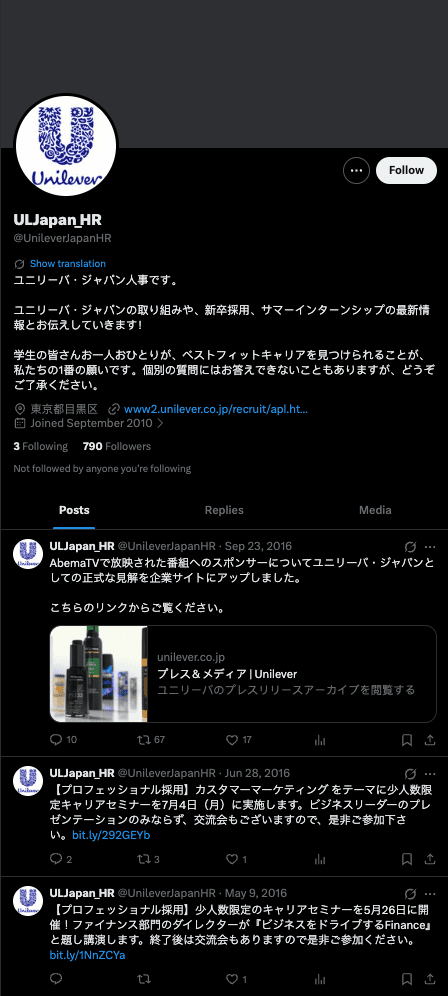
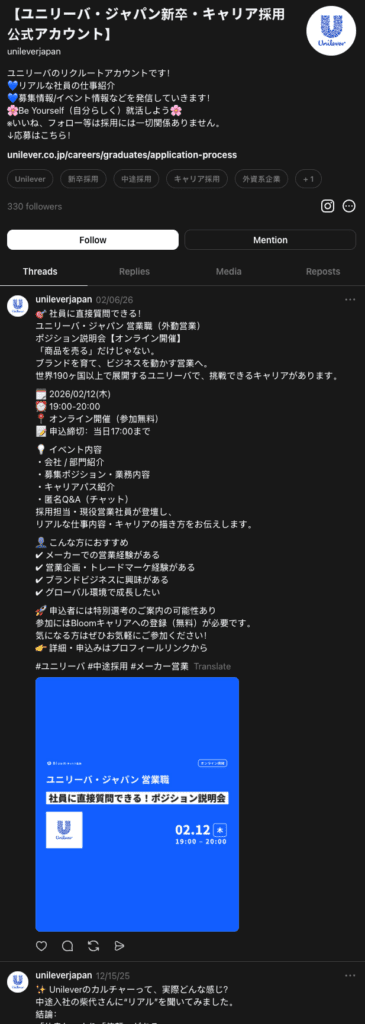
The framing that matters here is functional reallocation, not platform replacement. Unilever Japan did not leave X because Threads surpassed it in global mobile DAU. That data did not exist in 2016. The decision was driven by audience fit and communication objective. That sequencing is the model: define the job first, then identify which platform mechanics serve that job for the audience you are actually trying to reach in Japan.
Strategic Framework: Rebalancing the Platform Roles
Why Replacing X is Premature
X’s continued relevance in Japan is rooted in discovery and real-time information flow. Even when engagement is inconsistent, the platform can act as a rapid distribution layer around events, trends, and fast-moving narratives, which is relevant for seasonality, product drops, influencer moments, and risk management when a brand needs to respond quickly. Shifting resources based on a single mobile DAU crossover also carries real costs: audience fragmentation, resource dilution, and the loss of platform equity that took years to build inside Japan’s X-embedded culture.
The Complementary Role of Threads
Threads is better positioned as a compounding channel. It supports deeper community building through routines, Q&A formats, and comment-led participation that keeps content alive beyond the first few hours. It rewards brands that act less like broadcasters and more like hosts.
Health & Wellness Application: Tailoring content for different segments: Fitness, Beauty, and Supplements.
Before assigning platform roles, the more useful question is what the brand needs to accomplish. A product launch has different platform requirements than a recruitment push or a long-term education series. Brand positioning matters too: a clinically oriented supplement brand and a lifestyle fitness brand are not competing for the same kind of attention on either platform. Getting that clarity first makes the role assignment below executable rather than theoretical.
A practical way to operationalize Threads vs X in Japan is to assign roles, then build content systems that match those roles:
- X: real-time relevance, updates, trend participation, and campaign amplification.
- Threads: conversational depth, habit-building series, Q&As, and credibility-first explainers.
- Shared layer: consistent positioning, guardrails, and claim-safe language across both platforms.
From there, treat testing like a strategy exercise, not a trend reaction. For regulated wellness categories, build a simple review process that accounts for each platform’s format, especially replies and quote reposts, so claim-safe language and evidence standards hold up in real conversations. Set a 6 to 8 week pilot where Threads is given a clear job, then evaluate using indicators that match that job, while keeping X focused on monitoring, timely posting, and cultural participation tied to real moments.
Conclusion: A High-Level Strategy for 2026
Summary of Insights
Threads surpassing X in global mobile DAU is a real milestone, but the strategic implication for Japan is not “switch,” it is “rebalance.” Japan remains one of X’s largest territories by ad reach, and the platform’s cultural role still supports discovery and participation at scale.
For health and wellness brands, Threads makes the most sense as a complementary platform that builds community depth and sustained interaction, while X remains a strong channel for real-time relevance and campaign amplification. The practical next step is to define the job of each platform, measure success against that job, and iterate based on what audiences in Japan actually do, not what global headlines imply. If it would help to translate that into a clear test plan, content system, and measurement approach, Pulse Marketing can help translate it into a plan the team can launch.