

Introduction: Why This Topic Matters
Japan’s health and wellness market continues to attract attention from brand teams because the demand drivers are structural rather than short term. Japan’s population is aging, with people aged 65 and over accounting for 29.3% of the total population as of October 1, 2024. At the same time, the Ministry of Health, Labour and Welfare continues to promote data-based health management and preventive-health initiatives, reinforcing a market environment where self-care, supplements, skincare, recovery, and adult fitness remain commercially relevant.
That makes channel selection in Japan especially important. Many global marketers default to Google for search and Meta for social discovery. In Japan, that is only part of the picture. Yahoo! JAPAN still matters because it combines search behavior, trusted portal traffic, editorial adjacency, and repeated daily usage inside one of the country’s largest digital ecosystems. According to Dentsu’s 2025 advertising expenditure report, internet advertising expenditures in Japan reached ¥4,045.9 billion in 2024, with paid search still a major driver of spend. In that environment, Yahoo deserves to be evaluated as a local planning tool rather than dismissed as a legacy platform.
While global marketers focus on Google and social platforms, Yahoo Japan remains a critical touchpoint for health-conscious consumers.
Overview of Yahoo Japan Ads Ecosystem
Core Ad Offerings
Yahoo’s ad ecosystem remains relevant for wellness marketers because it combines active demand capture with content-led discovery in a way that suits how many Japanese consumers research health-related purchases.
- LY Ads Search Ads support intent-driven targeting and function as Yahoo’s closest equivalent to Google Search.
- LY Ads Display Ads place banner, video, and native-style formats across Yahoo! JAPAN and LINE environments, including premium homepage and content placements.
- The strategic difference is that Yahoo is not only a search engine. It is also a content discovery platform where users read, compare, and validate before acting.
The LY Corporation Ecosystem: Yahoo + LINE
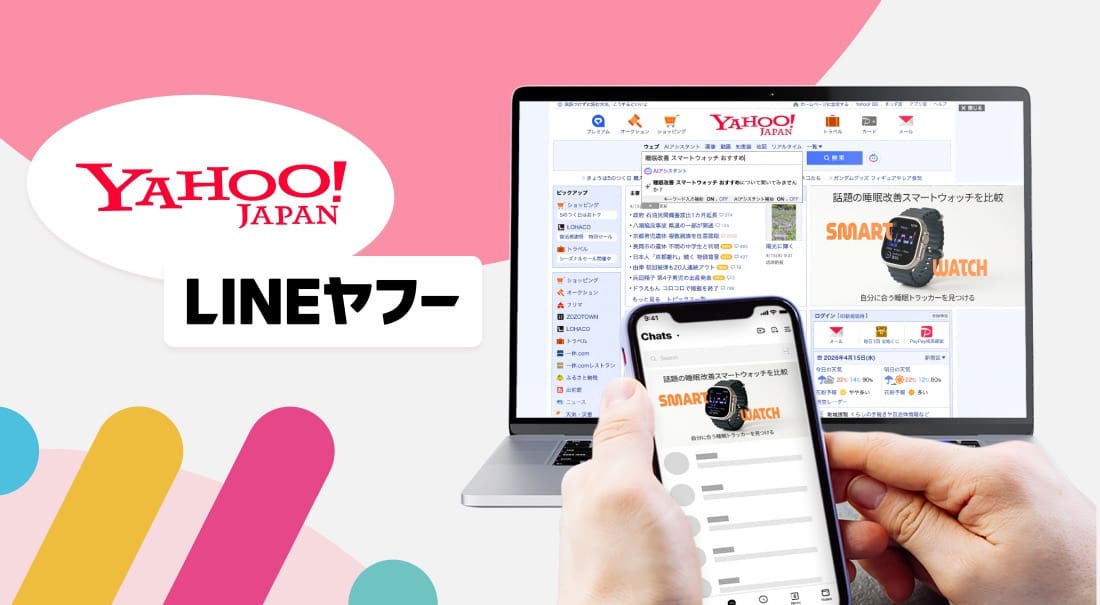
Yahoo! JAPAN and LINE both sit within LY Corporation, one of Japan’s largest technology groups spanning search, portal, communications, commerce, and advertising. LY Corporation’s media guide describes a combined environment with around 98 million LINE monthly active users in Japan and 54 million Yahoo! JAPAN monthly logged-in user IDs as of late March 2025.
That picture changed on April 1, 2026. Until then, Yahoo and LINE advertising were typically discussed as separate platforms, but from April 1, 2026, LINE Ads and Yahoo! JAPAN Display Ads were integrated under LY Ads Display Ads, while Yahoo! JAPAN Search Ads was renamed LY Ads Search Ads. In practical terms, display delivery across LINE and Yahoo! JAPAN is now more closely connected, while search remains a distinct campaign function even within the broader ecosystem journey.
Data & Audience Synergy (Unified Delivery Layer)
With the April 2026 launch of LY Ads Display Ads, LY Corporation has moved beyond ecosystem ambition into an unified delivery layer across LINE and Yahoo! JAPAN. The new platform enables advertisers to manage campaigns across both environments through a single setup and operational workflow, while consolidating ad delivery data into one platform to improve machine learning efficiency, optimization quality, and campaign performance.
For health and wellness brands, the strategic value lies in cross-surface audience sequencing across intent-rich and trust-building environments. A user may first signal category interest through Yahoo! JAPAN search or editorial engagement, then later be re-engaged across LINE and Yahoo! JAPAN display surfaces as the unified delivery layer optimizes toward likely responders. The unified delivery layer makes this progression more operationally coherent and optimization-friendly, which is especially valuable in cautious, research-heavy categories where conversion depends on repeated reassurance rather than immediate response.
Audience Profile: Health & Wellness Consumers on Yahoo
Yahoo’s audience profile helps explain why the platform still holds value for wellness campaigns in Japan. LY Corporation’s media guide describes Yahoo! JAPAN and the wider LY environment as reaching audiences across all age groups, with substantial usage on both smartphone and PC.
For wellness brands, the most commercially relevant traits are often these:
- Strong adult user base, especially among people in their 30s to 60s and beyond.
- Research-oriented behavior, with users comparing claims and reading supporting information before purchase.
- Trust sensitivity, which matters in supplements, skincare, preventive health, and adult fitness.
- Content consumption before conversion, supported by Yahoo’s mix of search, news, lifestyle, finance, and utility usage.
This does not mean Yahoo should be treated as an older-skewing platform alone. The more useful takeaway is that it performs especially well in categories where explanation, reassurance, and consideration matter.
Why Yahoo Ads Works for Health & Wellness Brands
Trust & Credibility
Yahoo can work well for wellness brands because credibility tends to matter more in this category than in many others. Ads tied to health, beauty, supplements, or preventive care are naturally more sensitive to consumer skepticism and platform review standards. LY Corporation emphasizes ad quality, systematic review, and detailed editorial and policy controls across its ad products. That environment can support higher perceived reliability than highly crowded, fast-scrolling social placements, especially when a brand is still building recognition in Japan.
Content Alignment
Yahoo also benefits from the context in which its ads appear. The platform is not limited to search results. It includes homepage inventory and content-rich environments that support discovery and research. For wellness advertisers, that allows campaigns to sit near content categories where users are already in an information-seeking mindset rather than a purely entertainment-led one.
Competitive Efficiency
Yahoo can also offer efficiency, although that should be treated as a planning hypothesis rather than a universal rule. In Japan, Google still leads search usage overall, with Statcounter showing Google at 59.58% of search engine market share in March 2026, while Yahoo accounted for 6.9%. That lower share does not make Yahoo irrelevant, rather, it can mean lower crowding in some auctions and a better cost-to-attention balance for categories where trust and context matter as much as raw scale.
Platform Comparison: Yahoo vs Other Channels
Yahoo is better judged by the role it plays in the funnel than by raw scale alone.
- Google Ads is strongest for bottom-funnel intent capture, but competition can be intense in wellness categories.
- Meta platforms are stronger for discovery and visual engagement, especially in beauty, skincare, and lifestyle-led wellness.
- LINE Ads is especially useful for remarketing, retention, CRM-style follow-up, and conversion support.
- Yahoo Ads sits between those roles, often performing best as a trust-building and consideration-driving channel with search support lower in the funnel.
The broader planning lesson is that these platforms play different roles: Google often captures demand, Meta can help create it, and LINE is well suited to re-engagement and retention. Yahoo’s strength is often earlier trust formation and mid-funnel consideration in a market where consumers may need more reassurance before acting.
Campaign Strategy for Health & Wellness Brands
Full-Funnel Approach
Yahoo is usually most effective when it is given a defined role within a broader channel mix. For many wellness brands, that means using it within a full-funnel sequence rather than expecting it to carry every objective alone.
At the top of the funnel, display ads should introduce the product problem, category relevance, or educational angle. In the middle of the funnel, retargeting and audience-based display can reinforce value, proof points, and relevance. At the bottom of the funnel, search ads should capture active demand around symptom terms, solution terms, ingredient terms, and product-specific queries, within policy limits. The recent addition of age and gender targeting in LY Ads Search Ads also gives advertisers more control over segment weighting than before.
Targeting & Creative Strategy
For targeting and creative, a small number of principles usually matter more than a long checklist:
- Prioritize adults aged 30 to 60+ in categories such as supplements, functional skincare, preventive care, and adult fitness.
- Use problem-driven queries because Japanese users often search by concern or outcome rather than by brand.
- Favor native-style creatives with clean layouts, informative headlines, and clear proof points.
- Include trust signals such as certifications, expert references, ingredient transparency, or carefully substantiated performance data where compliant.
- Keep the tone subtle and informative. Aggressive sales language and clickbait framing are usually a poor fit for Japanese wellness audiences.
Compliance should also be treated as part of campaign strategy, not a late-stage check. LY provides detailed editorial guidelines and account review guidelines, and health-related categories can trigger stricter handling. That is especially important for claims around efficacy, pharmaceuticals, cosmetics, supplements, and quasi-medical positioning. Requirements also vary materially by regulated category, so campaigns in pharmaceuticals, clinics, quasi-drugs, supplements, and medical-adjacent wellness products should be planned against the specific LY review standards and applicable PMD Act interpretations for that sector.
Budgeting
A practical planning model is to treat Yahoo as a meaningful, but not dominant, share of paid media for most health and wellness brands. In many cases, allocating around 20% of spend to Yahoo is a reasonable test or working benchmark, with the remainder split across Google for direct intent capture and LINE or Meta for retargeting, CRM, and discovery. That is a strategic recommendation rather than a fixed market rule. The right number depends on brand maturity, category complexity, and whether the goal is education, efficient demand capture, or full-funnel market entry.
The main budgeting principle is role clarity. Yahoo is often strongest in the middle of the funnel, where it can scale trust and consideration more effectively than many marketers initially expect.
Common Mistakes to Avoid
Even when the channel strategy is broadly sound, execution issues can weaken performance quickly. This is especially true in Japan’s health and wellness sector, where audience expectations, platform context, and regulatory sensitivity all shape how campaigns are received. In practice, the most common mistakes are not usually technical. They tend to come from applying the wrong creative assumptions or underestimating how much localization matters.
Several planning mistakes appear repeatedly in this space:
- Treating Yahoo like a social platform, with creativity that is too sales-driven or exaggerated.
- Failing to localize for Japanese audiences, especially on claims, tone, proof points, and landing page expectations.
- Overlooking older, high-value users, who are often central to wellness categories in Japan.
Conclusion
Yahoo Ads continues to occupy a distinctive place in Japan’s advertising ecosystem. It combines search intent, premium portal reach, editorial adjacency, and growing LY ecosystem connectivity in a way that many international marketers still undervalue. The platform’s 2026 shift into the LY Ads framework only reinforces the need to evaluate Yahoo through current local market realities rather than older global assumptions.
For health and wellness brands in Japan, Yahoo Ads is rarely the entire answer on its own. It is more valuable as part of a multi-platform strategy alongside Google, LINE, and, in many cases, Meta. Its strongest contribution is often not immediate last-click conversion, but trust-building at scale, education during the consideration phase, and more structured movement toward lower-funnel action. For brands in supplements, skincare, preventive health, and adult fitness, that can make Yahoo one of the most useful mid-funnel channels in the Japanese market.
Brands evaluating paid media in Japan’s health and wellness market often need more than a platform shortlist. Pulse Marketing supports health and wellness brands with channel strategy, localization, and campaign planning shaped around Japanese consumer behavior. For teams assessing the next step in Japan, contacting the Pulse team is a sensible way to start a more focused discussion.